





GO CLIMALACT: A commitment to innovation and sustainability in the dairy sector
Description
The CLIMALACT operational group It is making steady progress in its goal of transforming the dairy production model in Galicia and Asturias towards sustainability and climate neutrality. At a time when the dairy sector faces increasing environmental, social, and profitability challenges, this initiative emerges as a firm commitment to innovation, cooperation, and responsibility—seeking to ensure that the production of milk and dairy products adapts to the demands of the ecological transition.
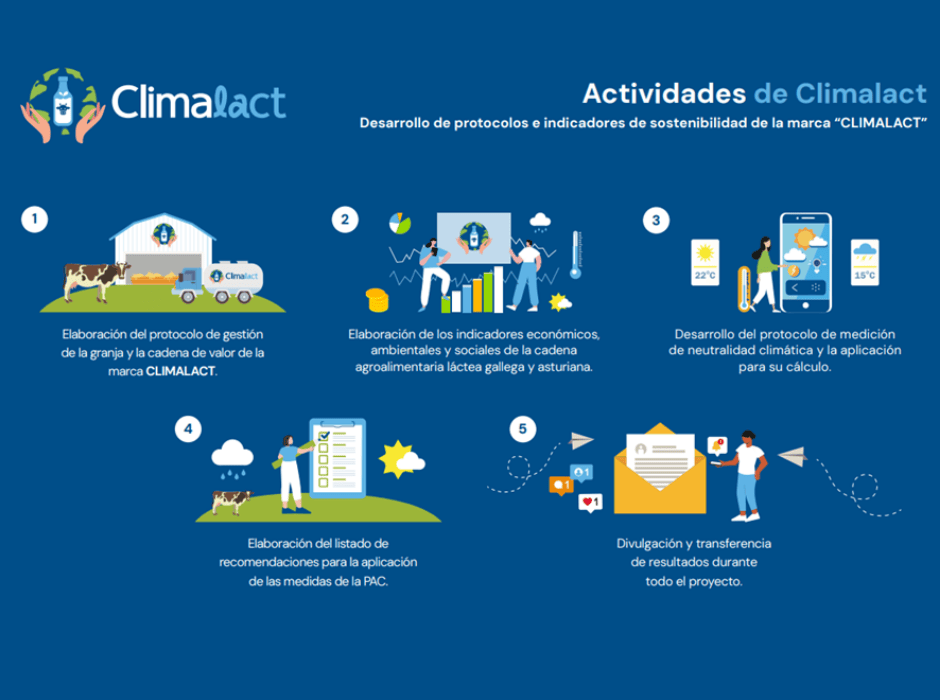
CLIMALACT was launched in 2024 with the goal of developing a sustainability and climate neutrality brand —the CLIMALACT brand—designed specifically for dairy farms and their value chain in Galicia and Asturias. The project analyzes both farm management and the production chain—including intensive and extensive systems, and various distribution channels—to identify, evaluate, and select existing best practices.
With a total budget of €600,000, co-financed 80% by EAFRD funds and 20% by the Ministry of Agriculture, Fisheries and Food, CLIMALACT is being developed between 2024 and 2027 as a supra-regional operational group.
The goal is ambitious: to define a set of productive, environmental, and social sustainability indicators; to develop clear climate neutrality protocols for each type of farm and value chain; and to create a software tool that allows for calculating the degree of compliance with these criteria. In this way, CLIMALACT aims to offer farmers, cooperatives, and dairy companies a viable roadmap for moving toward a more sustainable, transparent, and competitive model.
Next activity: focus group in Rodeiro (Pontevedra)
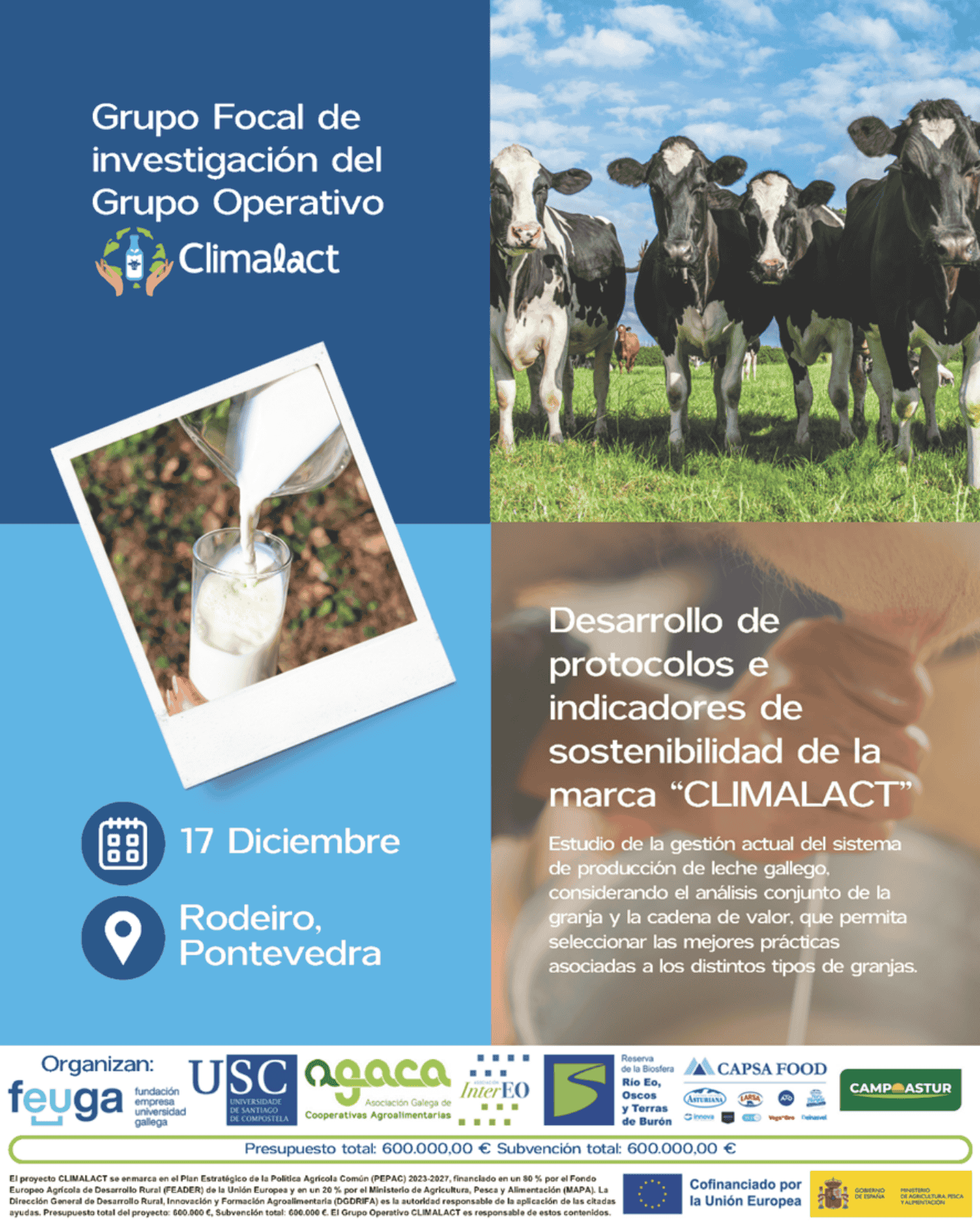
In this context, CLIMALACT is preparing the ground for the project's next step: resuming collaborative work through a new Multi-Stakeholder Focus Group, which will take place on December 17th in Rodeiro (Pontevedra) , with the participation of Galician producers, industry representatives, and other key stakeholders. With this, CLIMALACT reinforces its commitment to incorporating the real voice of farms into the definition of sustainability criteria, adapting them to the specific characteristics of the Galician rural environment—a fundamental challenge for consolidating a dairy model with a future.
This second working session with stakeholders in the sector aims to complete the work begun in the previous focus group, held in March 2025 in the Asturian municipality of Vegadeo. Thanks to this process, valuable information was obtained that is serving as the basis for designing management, sustainability, and climate neutrality protocols tailored to each type of farm.
Using data collected in Vegadeo, CLIMALACT has identified patterns and criteria that point to strengthening efficient management, reducing dependence on external inputs, diversifying production, and fostering cooperation among farmers, cooperatives, and advisors—key factors for improving the sector's sustainability and competitiveness. These findings form the basis of the initial analysis.
Now, with a new Multi-Stakeholder Focus Group scheduled for December 17th in Rodeiro (Pontevedra) , CLIMALACT is once again undertaking a collective data collection effort, this time focused on farms in Galicia. The aim is to incorporate data representative of the Galician reality, broaden the sampling to include different production models, and strengthen the robustness of the analysis, so that the resulting indicators and protocols accurately reflect the territorial and productive diversity of the dairy system in both regions.
This step will be fundamental to consolidating sustainable, transparent management adapted to the real context of farms in Galicia and Asturias, and to making sound progress towards climate neutrality in the sector.
Collaborative project: who makes CLIMALACT possible
CLIMALACT would not be possible without its network of partners: the Galician Business-University Foundation (FEUGA) assumes the coordination of the consortium, which also includes the Intereo Association , the Galician Association of Agri-food Cooperatives (AGACA ), and the companies Campoastur and CAPSA FOOD , essential actors due to their direct experience in the dairy sector and their ability to contribute farms with different production systems.
The scientific aspect is being handled by the University of Santiago de Compostela (USC ), through its Silvopastoral Systems Research Group, which is leading the development of sustainability and climate neutrality protocols and the development of a digital tool that collects the indicators and will allow farmers to know their level of compliance.
In this way, CLIMALACT combines research, real production and cooperative commitment around an ambitious goal: to transform dairy production in Galicia and Asturias towards a sustainable model, respectful of the environment and with a future in a market that is increasingly demanding in terms of ecological and social responsibility.
This innovation project falls within the framework of the Common Agricultural Policy Strategic Plan (CAPSP) 2023-2027 and is financed 80% by the European Agricultural Fund for Rural Development (EAFRD) of the European Union and 20% by the Spanish Ministry of Agriculture, Fisheries and Food (MAPA). The Directorate General for Rural Development, Innovation and Agri-food Training (DGDRIFA) is the authority responsible for implementing these funds. Total project budget: €600,000.00. Total grant: €600,000.00.
