






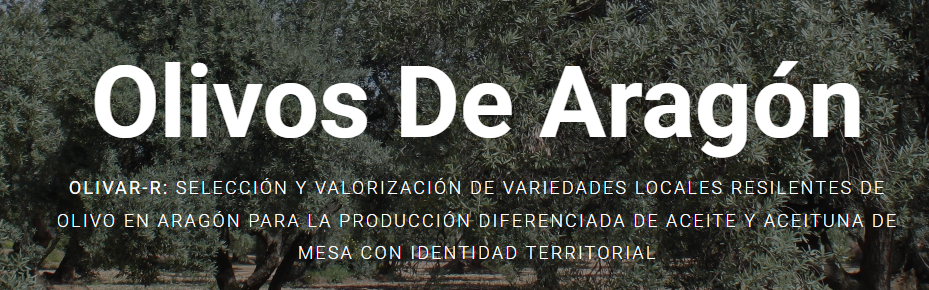
OLIVAR-R Operational Group: Selection and valorization of resilient local olive varieties in Aragon for the differentiated production of oil and table olives with territorial identity
- Type Operational group
- Status In progress
- Execution 2025 -2028
- Assigned Budget 149.999,00 €
- Scope Autonómico
- Autonomous community Aragón
- Main source of financing CAP 2023-2027
- Project website Web del proyecto
OLIVA-R aims to identify traditional and unique olive varieties adapted to arid dryland farming, requiring minimal water and fertilization. Genetic, morphological, and agronomic characterization will be carried out to prevent genetic erosion and preserve Aragon's heritage. A key outcome will be the creation of an interactive map of local varieties on the project website, useful for nurseries, producers, and olive mills. The project will promote the production of single-varietal extra virgin olive oils with unique profiles and introduce distinctive table olives, expanding the differentiated commercial offering. Socially, the project will strengthen rural development, local employment, and the sustainability of the olive oil sector.
The project activities are structured around four fundamental lines of action:
- Genetic prospecting and identification: An exhaustive search is being carried out in 200 Aragonese municipalities to locate unique specimens, documenting their geolocation, morphological characteristics, and ethnographic context through surveys of landowners. CITA performs DNA extractions and analyses with molecular markers to identify new genotypes and establish synonymies, comparing them with the World Germplasm Bank.
- Propagation and trials: The selected varieties are propagated vegetatively by cuttings in a nursery to ensure their future availability. Subsequently, trials are established at an experimental farm in Caspe to evaluate their yield potential, agronomic performance, and adaptation to the arid dryland climate, forming a core collection of unique varieties.
- Transformation and valorization: The suitability of olives for table use is analyzed through various curing protocols (brine, lye, wrinkled) and microbiological stability studies. Simultaneously, single-varietal Extra Virgin Olive Oils (EVOO) are classified through experimental extractions and physicochemical and sensory analyses to define unique organoleptic profiles.
- Dissemination and knowledge transfer: Communication activities are carried out through a specialized website, social media, and informational materials. The plan includes technical workshops, scientific publications, and the organization of public olive and olive oil tastings to promote the regional identity of these products.
The project aims to identify and genetically characterize local olive varieties in Aragon, prioritizing ecotypes resilient to dryland farming. Its goal is to enhance the value of this heritage through the differentiated production of olive oils and table olives with a distinct territorial identity, thereby improving the competitiveness and viability of regional olive farms.
- Update to the Aragon Olive Varieties Map, created in the OLIGAM project, with newly surveyed areas and updated variety fact sheets. Registration of new varieties in BGMO
- DNA analysis and identification of new olive varieties. Drafting of a report with the conclusions obtained in the process
- Nursery propagation of the new olive varieties identified in the surveys
- Creation of a collection of unique olive varieties.
- Valorization of differentiated local varieties and their introduction into the market after evaluation of the potential for the production of differentiated table olives.
- Valorization of differentiated local varieties and their introduction into the market after evaluation of the potential for obtaining single-varietal extra virgin olive oils with distinctive sensory profiles.
- Name of entity: Agri-food Innovation and Transfer Foundation of Aragon (FITA)
- Postal address: AVENIDA MONTAÑANA 930
- Email: info@fita-aragon.es
- Telephone: 976716976
- Entity name: OMEZYMA
- Postal address: Av. Aragón, 13, Torrevelilla 44641 (Teruel)
- Email: joaquin@omezyma.es
- Telephone: 639642678
- Entity name: ACEITES LIS, SL
- Postal address: Ctra. Alpartir, km. 1, La Almunia de Doña Godina 50100 (Zaragoza)
- Email: comercial@aceiteslis.com
- Telephone: 976600956
- Entity name: VIVEROS MARIANO SORIA, SL
- Postal address: Ctra. Cariñena, km. 4,800 La Almunia de Doña Godina 50100 (Zaragoza)
- Email: almunia@viverosmarianosoria.com
- Telephone: 976600167
- Entity name: AFRUCCAS
- Postal address: C/ Alcañiz, 17 Caspe 50700 (Zaragoza)
- Email: afruccas@gmail.com
- Telephone: 976630551
- Entity name: ANTONIA MOLINA
- Postal address: Calle Alcañiz 15 Caspe 50700 (Zaragoza)
- Email: contacto@mdemolina.com
- Telephone: 976630610
- Name of entity: Agri-food Research and Technology Centre of Aragon (CITA)
- Postal address: Avenida Montañana 930, 50059 Zaragoza
- Email: cita@aragon.es
- Telephone: 976716300
- Entity name: ADECOBEL
- Postal address: Plaza del Ayuntamiento, 1 duplicate 2nd left. 50130 Belchite (Zaragoza)
- Email: info@adecobel.org
- Telephone: 976830104
- Fundación de Innovación y Transferencia Agroalimentaria de Aragón (FITA)
- OMEZYMA
- ACEITES LIS, S.L.
- Viveros Mariano Soria, S.L.
- AFRUCCAS
- ANTONIA MOLINA
- Centro de Investigación y Tecnología Agroalimentria de Aragón (CITA)
- ADECOBEL