





Training courses
Destacados
22/04/2026
Cooperativas Agro-alimentarias CLM
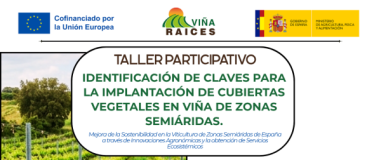
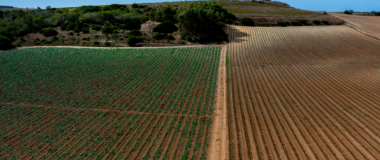
Identifying key factors for the implementation of plant cover crops in vineyards in semi-arid zones
Participatory workshop addressing topics related to the implementation of plant cover in vineyards in semi-arid areas: operation, profitability, common experiences. PROGRAM 09.00 H. RECEPTION AND OPENING Presentation of the GO VIÑA-RAÍCES consortium (UCAM, CAEx, CACLM). 9:30 AM. ITAP PRESENTATION STARTING POINT 10:00 AM. Analysis of the current
13/04/2026
Dirección General de Desarrollo Rural, Innovación y Formación Agroalimentaria. MAPA
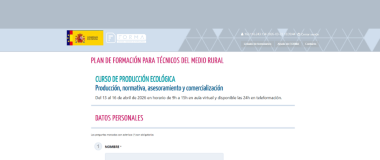
Organic Production Course on regulations, advice, production and marketing
From April 13 to 16, 2026, the Course on Organic Production: Production, regulations, advice and marketing will be held in virtual classroom and online training format, a training proposal aimed at delving deeper into the key aspects that define the present and future of organic production in Spain. The course will offer a comprehensive overview of
13/04/2026
Instituto Agronómico Mediterráneo de Zaragoza
Regenerative agriculture and sustainable soil management for greater climate resilience and food security in the Mediterranean
This course is designed for agricultural professionals, researchers, policymakers, and producers. Its objective is to provide advanced knowledge and practical tools for the design and implementation of regenerative agriculture and sustainable soil management practices adapted to Mediterranean agroecosystems. Faced with the urgent challenges of

06/04/2026
iRiego
Registration is now open for the free online course "Digitization of meteorological data and pest detection"
iRiego has opened registration for the free online course “Digitization of Meteorological Data and Pest Detection” , which will be held from April 6 to 8, 2026. This training will focus on the use of meteorological data to improve irrigation management and optimize decision-making in agriculture. The course will allow participants to delve into the

11/03/2026
Cajamar
Free webinar: CYVCV (yellow vein chlorosis), a new threat to Spanish citrus farming
Spanish citrus farming faces a new phytosanitary challenge with the detection of the Citrus Yellow Vein Clearing Virus (CYVCV) , first identified in Spain at the end of 2025 and initially confirmed in Catalonia and later in the Valencian Community . In this context, Cajamar , in collaboration with Generalitat Valenciana and IVIA , is organizing a
21/10/2025
MAPA
For advisors: Agricultural and livestock farms – Production, innovation, advice and marketing –
The Ministry of Agriculture, Fisheries and Food (MAPA) is organizing the online course “Agricultural and livestock farms: Production, innovation, advice and marketing” in October 2025 , within the framework of the 2025 Training Plan. The training will be delivered in virtual classroom and e-learning mode , with sessions on alternate days ( October

07/07/2025
IBADER
Summer Course - USC: Nature Restoration: Challenges, Strategies and Proposals for Action.
1.- General information about the University of Veran: The USC Summer University offers a wide range of courses in June, July, August, and September, with various centers of interest in Compostela, Lugo, and various Galician towns. Registration for Summer University courses opens in mid-May and remains open until ten days before the start of each
05/05/2025
Universidad Católica Santa Teresa de Jesús de Ávila
Microbial biofertilizers 4.0
Organized by the Santa Teresa de Jesús Catholic University in Ávila, this course will allow students to learn about the latest technologies associated with the development of biofertilizers based on the study of the soil microbiome (analysis of microbial populations associated with agricultural soil), through the collection of bioinformatics data
11/07/2024
UNED
Sustainability and food systems
From a multidisciplinary perspective, the relationship between Biosphere Reserves as territories will be discussed, whose objective is to harmonize the conservation of biological and cultural diversity, and economic and social development through the relationship between people and nature. The environment chosen for this debate is the island of