





Media Library

Documentary, graphic and/or audiovisual knowledge objects are offered here, offering information on various sectors and topics. Use the keyword search or search filters to access current audiovisual and documentary knowledge objects useful for your implementation.

If you have any questions or suggestions, please contact us here.

Phytosanitary bulletin of notices and information

Pollinating insects are vitally important for the proper functioning of crops. Pollination is essential to ensuring the quantity and quality of crops and food production, directly linking wild ecosystems with agricultural production systems.

Webinar - How does digitalization impact pest and disease control in greenhouse crops?

How does digitalization impact pest and disease control in greenhouse crops?

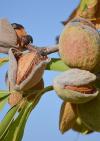
Behavior of new almond varieties in the Cartagena countryside

The rise in almond prices in recent years, a consequence of strong global demand, is causing a revolution in this crop, with a significant increase in the cultivated area in Spain.

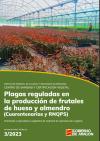
Regulated pests in stone fruit and almond production (Quarantine and RNQPS)

The entry into force of Regulation 2016/2031 has brought about numerous legislative changes. Among them is the classification of pests as quarantine, priority, and regulated non-quarantine pests. This classification, established by the European Union, entails specific levels of protection and the application of different measures.

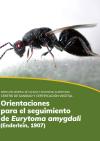
Guidelines for monitoring Eurytoma amygdali

In recent years, Eurytoma amygdali has spread throughout the Autonomous Community of Aragon in a manner similar to its spread in other parts of Spain, and this expansion is expected to continue. Currently, pheromone-based attractants or other semiochemicals are not available that would allow for reliable monitoring of adult almond populations to determine optimal treatment times.

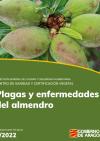
Pests and diseases of the almond tree

In recent years the area dedicated to almond cultivation has experienced significant growth in Aragon; currently, some 83,800 hectares of almond trees are cultivated.

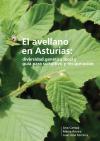
The hazelnut tree in Asturias

The European hazelnut (Corylus avellana L.) is a traditional crop in Asturias, whose importance was already documented in 1711 by Fray Toribio Santo Tomás y Pumarada (2006). However, at the end of the 20th century, this crop declined in the region due to the low price of its fruit and the demographic decline in rural areas.

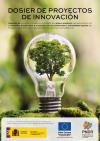
Dossier of supra-autonomous innovation projects

Inventory of innovative projects implemented by supra-regional operational groups of the European Innovation Partnership for agricultural productivity and sustainability of the National Rural Development Programme (PNDR) 2014-2022, submeasure 16.2.

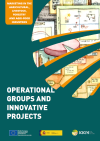
Marketing In Agricultural, Livestock, Forestry And Agri-Food Industries. Operational Groups And Innovative...

English translation of a compilation of projects developed through EAFRD funds, operational groups and innovative projects working in marketing in the agricultural, livestock, forestry and agri-food industries sectors.

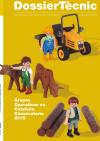
Operational Groups in Catalonia. Call for 2018

"Technical Dossier No. 123: “Operational groups in Catalonia. Call 2018” is dedicated to the Operational Groups developed within the framework of the CAP Strategic Plan (PEPAC 2023-2027), and taking into account the Agricultural Knowledge and Innovation Systems, also known as AKIS (Agricultural Knowledge and Innovation System).

Online workshop: Advanced advisory skills for agricultural advisors in the field of technological solutions for digital agriculture

In this online workshop, organized by QuantiFarm in collaboration with EUFRAS, on November 28, 2024, farmers, rural consultants and other stakeholders had the opportunity to delve deeper into:

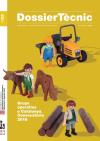
Grups operatius a Catalunya. Call 2018 (Catalan)

The Technical Dossier no. 123: “Grups operatius a Catalunya. Call 2018” is dedicated to the Groups Operatius developed within the framework of the CAP Strategic Plan (PEPAC 2023-2027), and includes the Agricultural Knowledge and Innovation Systems, also linked to AKIS (Agricultural Knowledge and Innovation System).

Behavior of the Main Pistachio Varieties

One of the key aspects for successful cultivation is the correct variety selection. This publication presents the initial results of a study on the performance of the main pistachio varieties, conducted by the Mediterranean Fruit Growing team at IFAPA.

Biohealthy Compounds of Pistachio

The results of a study of 11 pistachio varieties grown in Andalusia during the 2019 and 2020 seasons are presented, assessing their total phenolic compound content, antioxidant activity, carotenoid content, and chlorophyll content. The color of the shell, the integument, and the interior of the fruit are also studied.

Preliminary study of deficit irrigation in almond trees

Results of trials on different deficit irrigation strategies in almond cultivation carried out in the 2013 and 2014 campaigns.

Guide to ground cover in almond trees

Living vegetation cover is considered the most appropriate soil management system, except in cases where adequate control is not possible.

Bitter Almond Detection by Near Infrared Spectroscopy (NIRS)

Near Infrared Spectroscopy (NIRS) is a non-destructive analytical technique that allows the differentiation of bitter almonds, with more than 5 mg/g of amygdalin, from non-bitter almonds.

Irrigation recommendations for almond cultivation in Andalusia under drought conditions

In recent years, almond cultivation has gone from being relegated to unproductive, dryland areas to becoming a clear alternative to other traditional crops in highly fertile agricultural areas, making intensive use of irrigation.

Almond irrigation app: a tool for managing irrigation in almond trees

The document describes and demonstrates the benefits of the Almond Irrigation App, a decision-making tool for farmers and technicians in the irrigated almond sector.

Sustainable woody cropping systems. Almond cultivation. Operation 10.1.6

This document is addressed to those almond farm owners who are beneficiaries of aid under the Agri-Environment and Climate measure, with the aim of informing them of the mandatory requirements to be met, as well as arguing the reasons for this aid and the purpose it seeks to achieve, in order to understand the commitments required.