





Media Library
Documentary, graphic and/or audiovisual knowledge objects are offered here, offering information on various sectors and topics. Use the keyword search or search filters to access current audiovisual and documentary knowledge objects useful for your implementation.
If you have any questions or suggestions, please contact us here.
Destacados
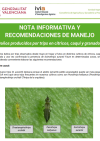
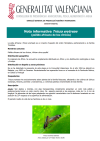
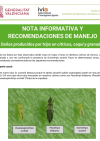
Information note and management recommendations: thrips damage to citrus, persimmon, and pomegranate.
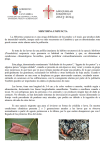
Given the damage caused by thrips observed since May on leaves and fruit in various citrus, persimmon and pomegranate crops and the confirmation of the presence of Scirtothrips aurantii Faure in certain areas, the following recommendations have been considered appropriate:
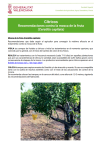
Recommendations against fruit fly (Ceratitis capitata) in citrus fruits.
Fruit fly (Ceratitis capitata). Recommendations for farmers to achieve maximum effectiveness in fruit fly treatment.
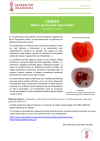
Drosophila suzukii treatment notice for cherry trees
In the various areas where Drosophila suzukii is being monitored, populations of this insect are being detected. Remember that attacks tend to be more intense and frequent at the beginning of the harvest, and treatment will be especially necessary in plots that were attacked in previous years and that left cherries unharvested last year (fly damage or cracking, lack of profitability, etc.).
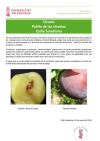
Notice of treatment of plum moth (Cydia funebrana) in plum trees
The second generation of the plum moth has been seen flying between late May and early June in the Ribera and Val d'Albaida regions, and somewhat later in inland areas. Eggs will hatch this week and next. Treat accordingly.
Field manual for the prevention of the bacterial disease known as HLB (Huanglongbing, greening...)
Field Manual for the Prevention of HBL (Huanglongbing), a bacterial disease that affects the plant's vascular-phloem system and causes the death of citrus fruits: oranges, mandarins, lemons, grapefruits, limes, and other citrus fruits. Spread by insect vectors: Trioza erytreae and Diaphorina citri. Target organs: leaves, stems, roots, and fruits.
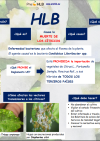
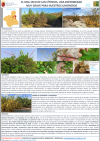
General information poster for the prevention of the bacterial disease known as HLB (Huanglongbing, greening...)
Poster with general information for preventing the bacterial disease HBL (Huanglongbing, greening, etc.), which affects the plant's phloem. The causative agent is the bacterium Candidatus Liberibacter spp.
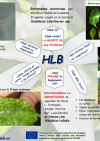
Information poster for the prevention of the bacterial disease known as HLB (Huanglongbing, greening...)
Information poster with general information on preventing the bacterial disease HBL (Huanglongbing, greening, etc.), which affects the plant's phloem. The causative agent is the bacterium Candidatus Liberibacter spp.
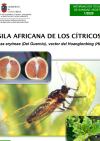
Information note Trioza erytreae (African citrus psyllid)
The African psylla (Trioza erytreae) is a sucking insect of the order Hemiptera, belonging to the family Triozidae.
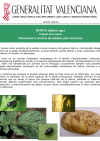
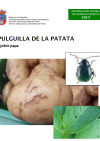
Technical information on the potato flea beetle (Epitrixs pp.)
The potato flea beetle refers to several species of the Epitrix genus, which are primarily considered pests of potato crops, although they can also affect other Solanaceae crops such as peppers, tomatoes, and eggplants.
Fact sheet on Scirtothrips dorsalis
Scirtothrips dorsalis Hood, known as chili thrips, tea yellows, or flower thrips, is a harmful organism classified as a quarantine pest. It is an insect native to southern and eastern Asia and has a wide range of host plants (more than 150 species), including commercial crops such as beans, tomatoes, eggplant, cucumber, onion, and peppers.
Poster of poorly dried citrus fruits
Citrus blight, a very serious disease for our lemon trees.
National contingency plan Plenodomus tracheiphilus [= Phoma tracheiphila] (citrus dieback)
This document sets out the measures to be taken against the fungus Plenodomus tracheiphilus (syn. Phoma tracheiphila), an organism regulated in the European Union (EU) by Directive 2000/29/EC, with the aim of preventing its appearance and, if it does appear, acting quickly and effectively, determining its distribution and combating it in order to prevent its spread and eradicate it.
National contingency plan Pomacea maculata (= P. insularum) (apple snail)
This document sets out the measures to be taken against gastropod mollusc species of the genus Pomacea, a quarantine pest in Europe, with the aim of preventing their appearance and, if they do appear, acting quickly and effectively, determining their distribution and combating them with the aim of eradicating them.
Scirtothrips dorsalis, biology and symptoms
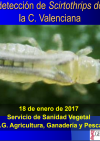
First detection of Scirtothrips dorsalis in the Valencian Community
Scirtothrips aurantii, information note and management recommendations, damage caused by thrips in citrus, persimmon and pomegranate.
Given the damage caused by thrips observed since May on leaves and fruit in various citrus, persimmon and pomegranate crops and the confirmation of the presence of Scirtothrips aurantii Faure in certain areas, the following recommendations have been considered appropriate:
Plant health, pest sheets: Ripersiella (Rhizoecus) hibisci
R. hibisci is a polyphagous mealybug that feeds on the roots of potted plants, reducing the absorption of water and nutrients by the plant and even causing its death.
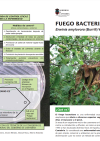
Plant health, pest reports: Erwinia amylovora (fire blight)
Fire blight is a disease caused by the bacterium Erwinia amylovora that affects various species of the Rosaceae family, including pear, apple, quince, and Japanese medlar trees. It was detected in Cantabria in 2011 and is considered an extremely harmful disease.
Plant health, pest sheets: Mhytimna unipuncta
Mhytimna unipuncta is a defoliating caterpillar of meadows and corn, which causes damage of varying intensity, although it is increasingly common in Cantabria and in certain areas can cause some alarm among the population.
African citrus psylla (Trioza erytreae)
A sucking insect belonging to the Triozidae family. Commonly known as the African citrus psyllid, it is native to sub-Saharan Africa. It is widely distributed in Africa and to a limited extent in the Middle East and Europe. It was detected in Spain in 2002, in the Canary Islands, and in 2014 in the Iberian Peninsula, Galicia, and northern Portugal.
Potato flea beetle (Epitrix papa)
Defoliating beetle of American origin that owes its name to the ability of adults to jump when disturbed. It was detected in Europe in 2008, in Portugal. In Spain, it was detected in Galicia in 2009, and in Asturias in 2014. It is considered a quarantine organism due to the loss of commercial value of tubers.