






The Spanish AKIS coordinating body approves its roadmap for 2026 and strengthens the alignment between science, innovation and the agri-food sector
Description
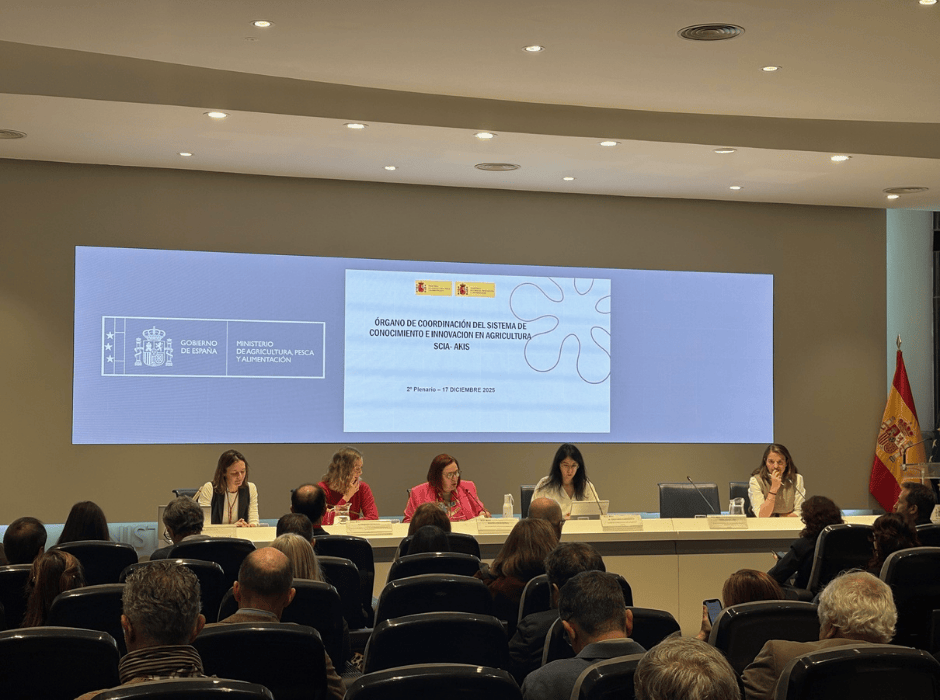
On December 17, 2025 , the second plenary meeting of the Coordinating Body of the Knowledge and Innovation System in Agriculture (SCIA-AKIS) was held at the headquarters of the Ministry of Agriculture, Fisheries and Food in Madrid. The session took place in person and was co-chaired by the Secretary of State for Agriculture and Food, Begoña García Bernal , and the Secretary of State for Science, Innovation and Universities, Juan Cruz Cigudosa .
During the meeting, the roadmap of the coordination body for 2026 was approved, consolidating this space as a key instrument for the coordination of agricultural, scientific and innovation policies, the strengthening of the governance of the Spanish AKIS and the improvement of knowledge transfer to the territory.
Science, innovation and public policy coordination
In her opening remarks, the Secretary of State for Agriculture and Food emphasized that the Spanish AKIS coordinating body plays a strategic role that the European Union considers essential for promoting innovation and supporting the digital and ecological transitions in the agri-food sector. She underscored the importance of moving towards a more cooperative approach, incorporating diverse perspectives, and of using this framework to foster generational renewal, access to knowledge and innovation, the integration of a gender perspective, and the attraction of talent.
In this context, Begoña García Bernal argued that it is necessary to " take full advantage of " the strengths of the Spanish agri-food system, one of which is precisely " innovation in the agri-food sector ." She referred to the sector as strategic , highlighting its resilience and adaptability , and noted that innovation and digitalization are fundamental elements for attracting women and young people , as well as for boosting family farming .
For his part, the Secretary of State for Science, Innovation and Universities, speaking via videoconference, emphasized that “ the effective integration of research, development, and innovation is essential for moving towards a more competitive, sustainable, and resilient agri-food sector .” Along these lines, Juan Cruz Cigudosa pointed out that the goal is for “ scientific infrastructures, technology centers, and universities to consolidate their position as strategic allies of the agri-food sector ,” facilitating knowledge transfer and accelerating the adoption of advanced technologies throughout the entire value chain.
She also emphasized the need to strengthen coordination among the various actors in the system and highlighted the Complementary Plan of the Ministry of Science, Innovation and Universities , a co-governance strategy with the autonomous communities aimed at aligning funds and objectives in strategic R&D&I areas, including agri-food. She also referred to the role of sandbox environments as tools to facilitate the experimentation of innovative solutions under real-world conditions and regulatory supervision.
A strategic body serving the governance of AKIS
The Coordinating Body of the Agricultural Knowledge and Innovation System (SCIA-AKIS) was established in May 2024 with the aim of facilitating the coordination of agricultural and scientific policies , strengthening governance and relationships among the various stakeholders, and contributing to a more competitive, innovative, and results-oriented agricultural sector . This coordination mechanism allows for the identification of needs, the guidance of public policies, and the improvement of knowledge and innovation transfer to the local level.
Training Working Group: adapting skills to the needs of the sector
The section dedicated to the Training Working Group was presented by Elena López de Coca López de Sancho, technical director of the Directorate General for Rural Development, Innovation, and Agri-food Training. She outlined the work carried out during 2024 and 2025 and the results of the survey administered to the members of the body, which allowed for the identification of priorities and the formation of three subgroups: University Training , Vocational Training , and Continuing Education .
The common objectives of these subgroups include updating training curricula , strengthening the practical component of training, developing digital skills , and valuing professional experience. The plenary session approved the group's operating manual and roadmap for 2026, which outlines the start of work by the three subgroups and the preparation of reports that will be incorporated into the general conclusions of the Training Working Group.
Advisory Working Group: a key axis for the sector's transition to more competitive models
The Advisory Working Group presented the progress of its various thematic subgroups. The presentation was coordinated by Maite Ambrós Mendioroz , Deputy Director General for Innovation and Digitalization at the Directorate General for Rural Development, Innovation and Agri-food Training, who emphasized that advisory services are an essential tool for ensuring equal opportunities in the agri-food system and for promoting the ecological transition and digitalization of the sector.
Maite Ambrós also highlighted the role of the AKIS Advisors Platform as a meeting point and showcase for the AKIS ecosystem in Spain, facilitating access to information, technical resources, training and professional networks for the advisor community.
The subgroups addressed areas such as sustainable nutrition , organic production , support for young and new farmers , digital transformation , innovation , and plant health . Common conclusions included identified needs related to continuing education, updated technical resources, support networks, regulatory harmonization, the use of digital tools, and strengthening mentoring to ensure generational renewal within the advisory community itself.
R&D&I Working Group: European opportunities and rural bioeconomy
The R&D&I Working Group was presented by Elisa Rivera Mendoza, Director General of Planning, Coordination and Knowledge Transfer at the Ministry of Science, Innovation and Universities. In her address, she highlighted the role of the Horizon Europe programs and the State Plan for Scientific, Technical and Innovation Research 2024–2027 as key instruments supporting research and innovation.
The opportunities foreseen in Cluster 6 of Horizon Europe for the period 2026–2027 were highlighted, particularly in the areas of food systems , the circular economy , the bioeconomy , and biodiversity . The roadmap for 2026 includes the launch of work by a subgroup focused on R&D&I needs and opportunities in the bioeconomy in rural areas , in coordination with the counterpart group in the advisory area, as well as the development of the agrifoodtech sandbox as an initiative to accelerate the arrival of innovative solutions to the market.
Present and future of the Spanish AKIS coordinating body
In the final block of the session, Isabel Bombal Díaz , Director General of Rural Development, Innovation and Agri-food Training, pointed out that the Spanish AKIS has a shared strategic vision , reinforced by a set of instruments already deployed by the MAPA to promote innovation and knowledge transfer.
Among these initiatives, he highlighted the Digitalization Strategy for the agri-food sector , the Agri-food Training Strategy , the promotion of EIP-AGRI Operational Groups —due to their multi-stakeholder nature and their capacity to address real needs in the sector—, support for knowledge sharing, and ongoing collaboration with various stakeholders through public-private partnerships . In this regard, he announced that the results of the latest call for Operational Groups will be published in the spring of 2026 .
Bombal emphasized the importance of aligning public innovation policies and ensuring the sector is aware of the available tools to address its needs. She also stressed that the Spanish AKIS coordinating body will enable the achievement of objectives that individual stakeholders could not reach. She announced that in 2026, collaboration between the various working groups will be strengthened and partnerships between them will be fostered. “ Only through coordination can we ensure that Europe recognizes the importance of investment in agri-food innovation and technological infrastructure for the sector ,” she concluded.